- Live MVP
- Individual Project
Financial Bridge
A working phone app that turns one sentence about a bad day into a 30-day plan for your money.
Your rent doesn't know you're in hospital.
Card bills, rent and insurance premiums keep arriving on schedule, whatever happens to the person paying them. Banks prepare for that kind of day with a business-continuity plan, yet most people have nothing like it for their own finances. Financial Bridge is that plan, built as a phone app. Tell it what happened in a single sentence, and it shows which payment breaks first, what could close the gap and who can help.
- Live
- At financialbridge.app, on fictional data. No sign-up.
- 1 sentence
- Is all it takes to start a plan.
- 3 tools
- The only way the money coach can get a number.
- 219
- Unit tests on calculations, AI checks and safety rules.
A 30-day outlook from 7 September. Hana is in hospital from 7 to 20 September, and the hospital bill leaves her KRW 273,000 short from 20 September.
Six screens, one bad day
Follow Hana, the sample user, from an ordinary afternoon to a car crash and on to a plan she can act on.
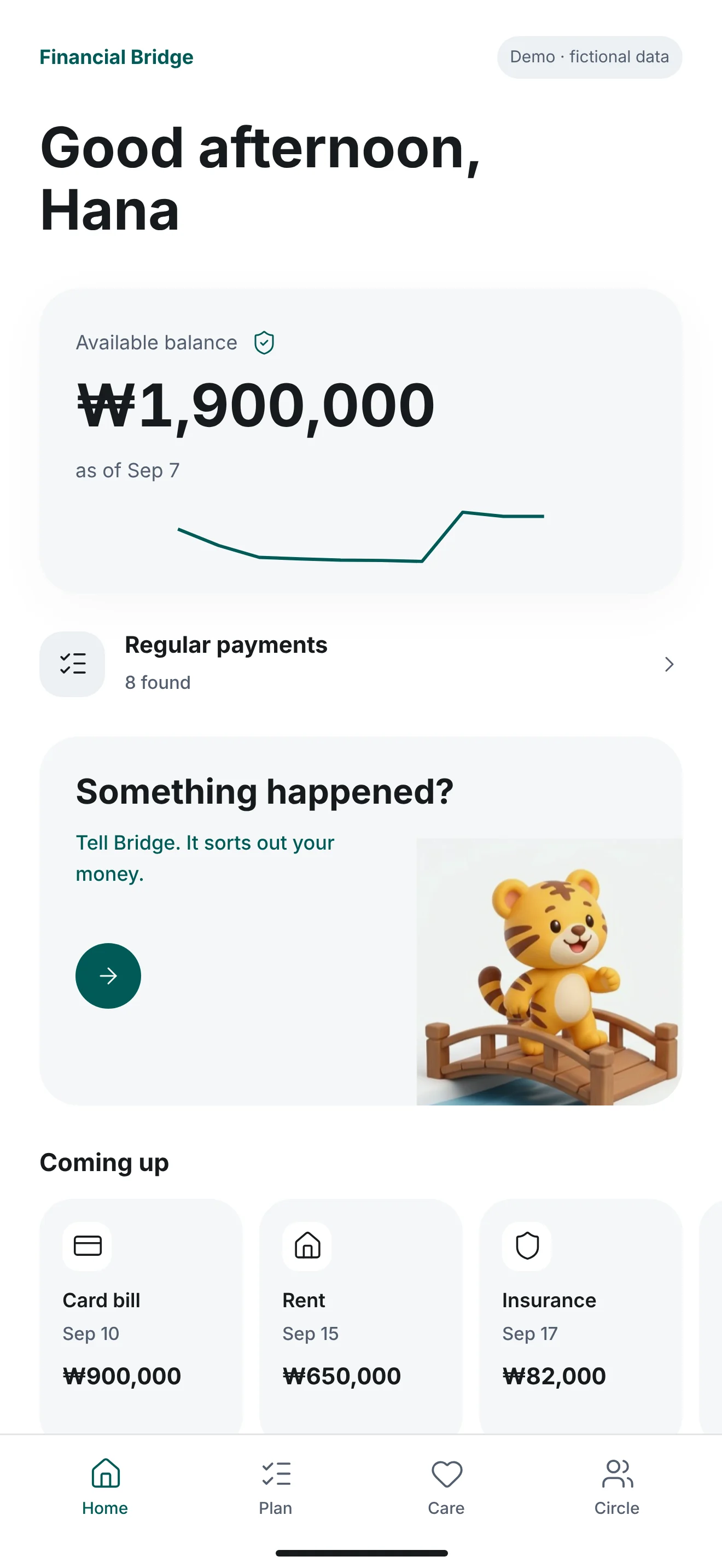
01Home
Ready before anything goes wrong. Gemini has already read three months of Hana's transactions and found her eight regular payments.
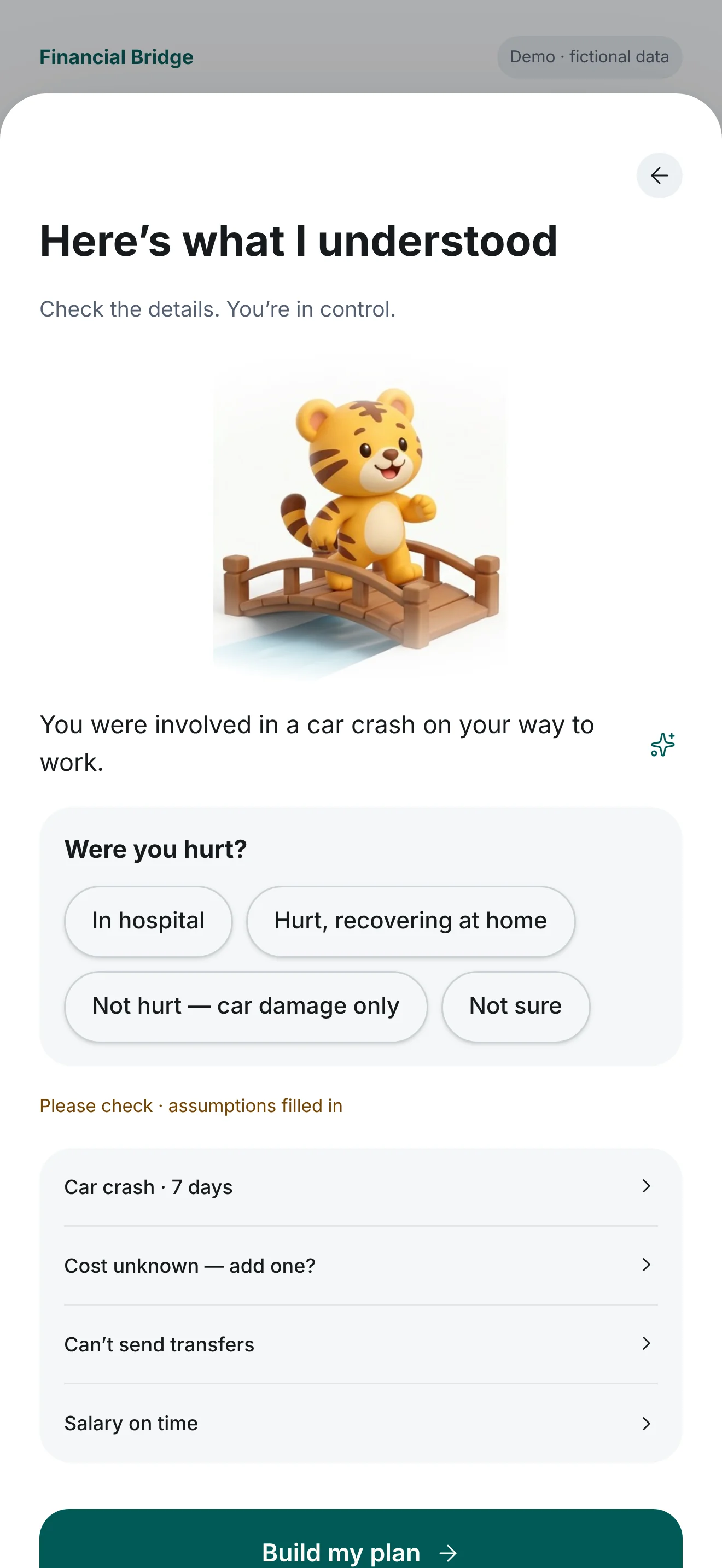
02Telling it what happened
One sentence starts the plan. Gemini asks a follow-up, such as "Were you hurt?", only when the answer would change it.
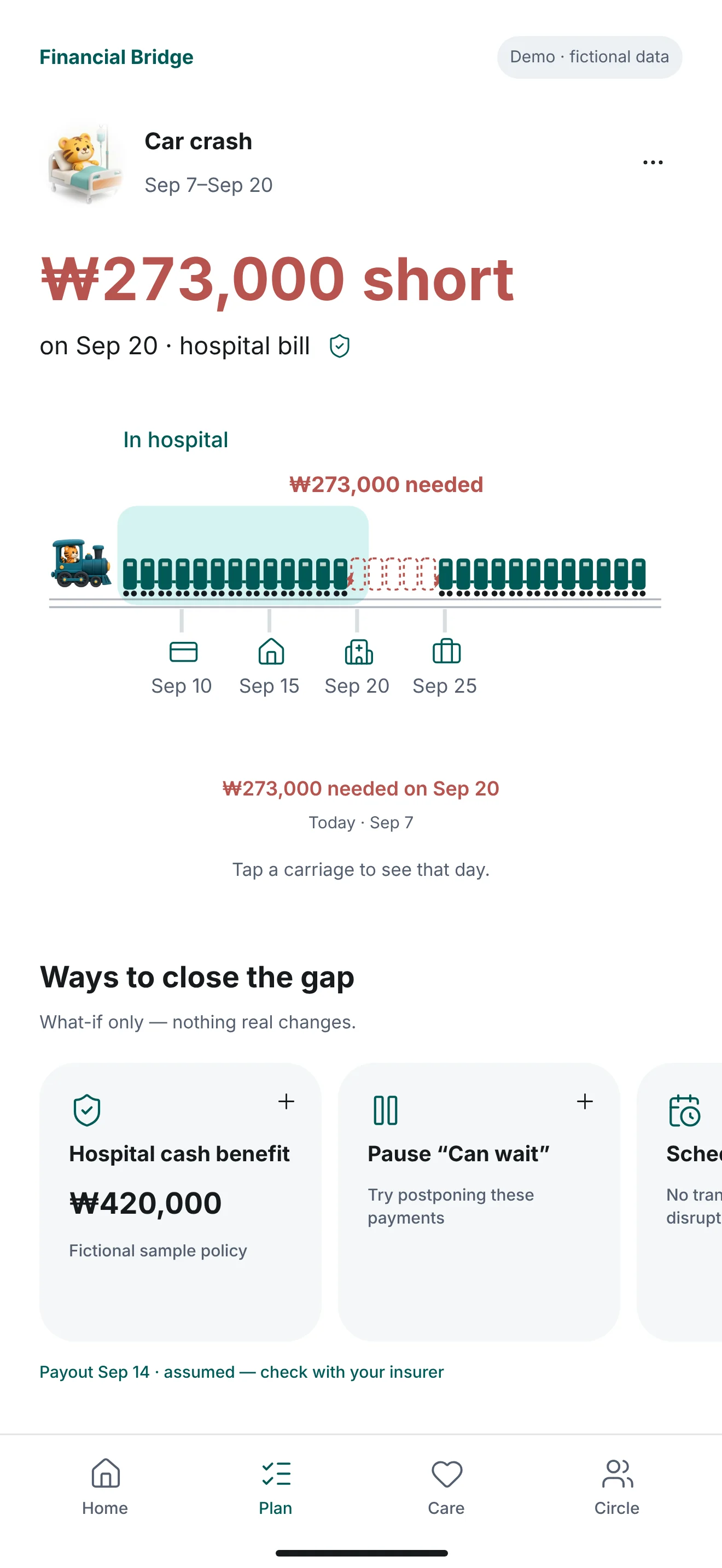
03The train
Thirty carriages, one for each day. The train breaks where the money runs out, KRW 273,000 short from 20 September.
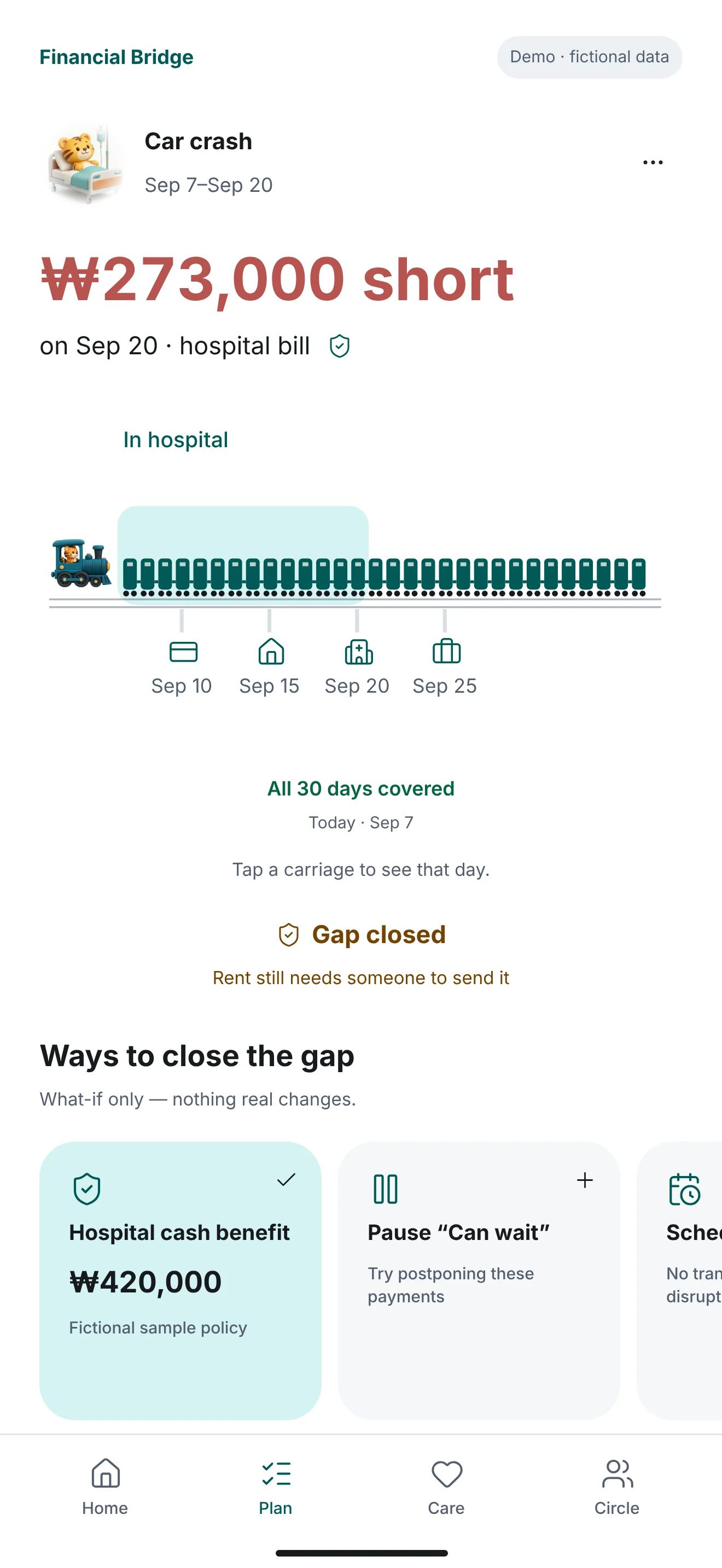
04Closing the gap
Each option reruns the same calculation on a copy of Hana's data, so she can try every one of them without moving real money.
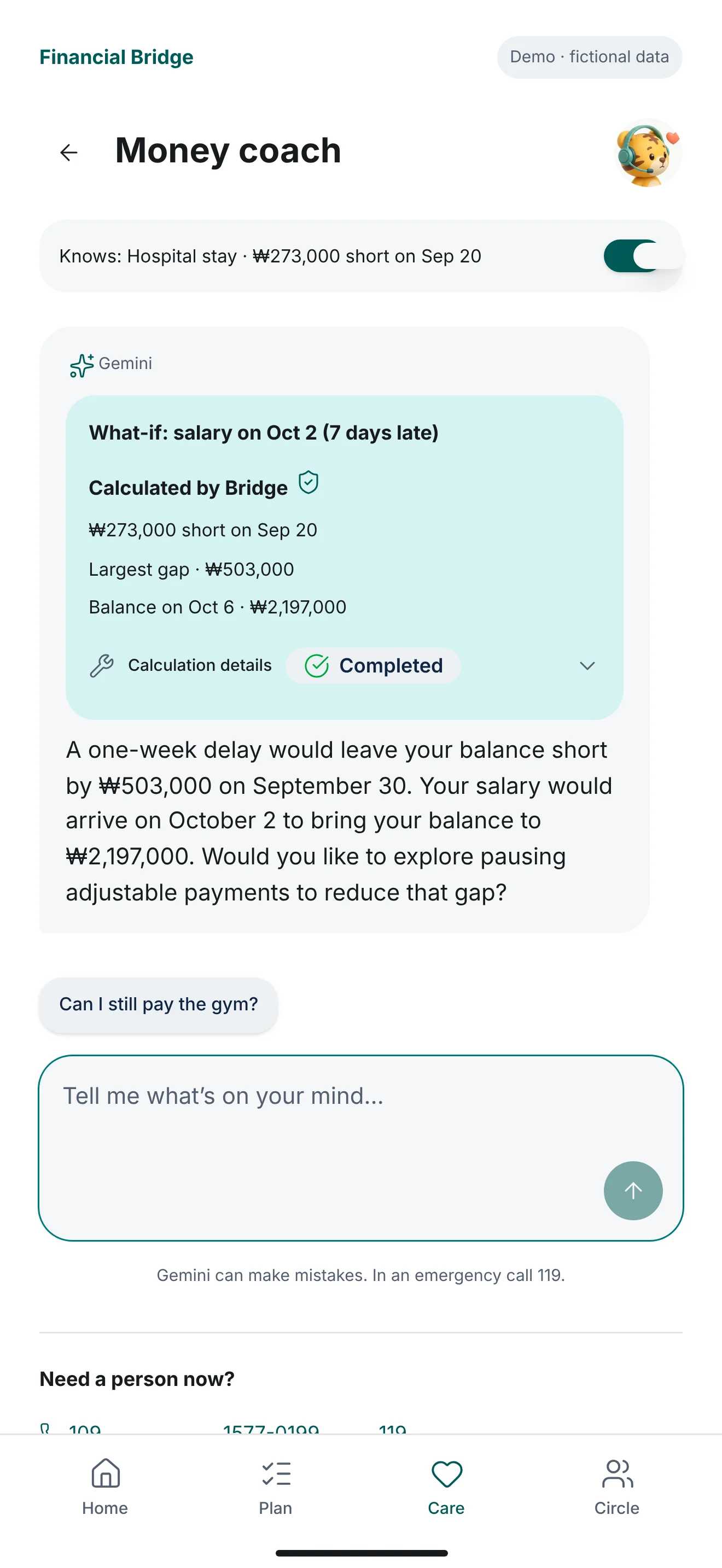
05Money coach
Ask anything and get a real number. The coach has to fetch every figure from one of three fixed tools, and it labels the result "Calculated by Bridge" before explaining it.
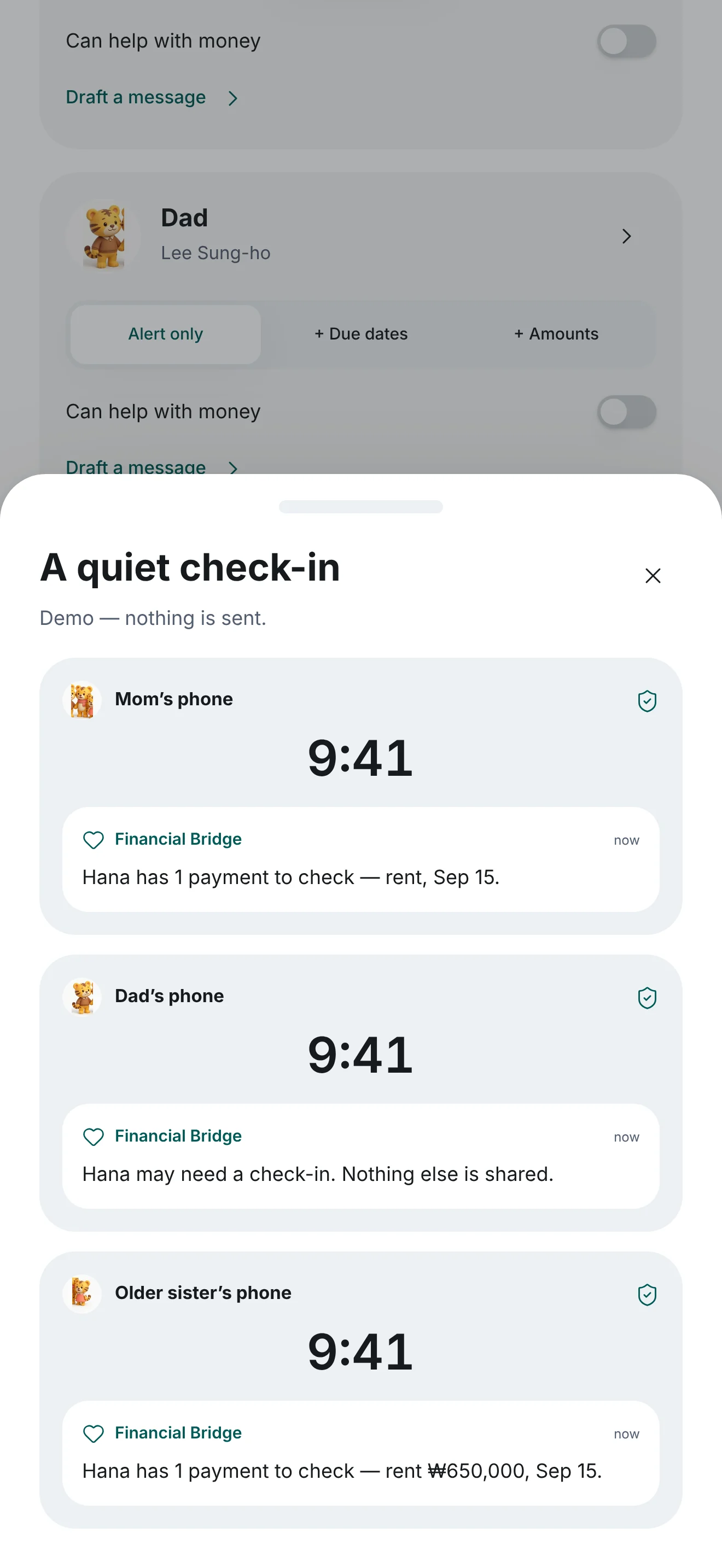
06Family
If Hana goes quiet for 48 hours in an emergency, each family member sees only what she chose to share. Nobody can move her money.
The decision that shaped everything
I started Financial Bridge with almost no coding background and built it with AI coding tools. That left my time for the questions that mattered most, namely what the AI should do and what it must never do.
Repeated stress tests settled the hardest of them. In a tool like this, a confident answer with the wrong date is worse than no answer at all, so calculation and explanation now live in separate places. A deterministic engine works out every balance, date and shortfall, and Gemini only explains the result. Any sentence whose numbers don't match the engine is dropped before anyone sees it.
What Gemini does
What the fixed logic does
Source: functional specification, p.3, AI and data processing.
Designed for the worst day
The person opening the app may be typing from a hospital bed, so every screen carries one message and one action. When a missing detail would change the plan, the app asks for it, and every assumption shows up as a line the user can edit.
Some things are fixed whatever the model says. Korea's 109 and 1577-0199 crisis lines and the 119 emergency number appear straight away, insurance claims only ever appear as what-ifs, and family members can look but never move the money.
What testing changed in version 2
Testing reshaped the product more than any plan did. A four-step form became a single prompt, "Something happened?". Once the app read "car crash" as a home repair, fixed rules began checking the input and asking "Were you hurt?" whenever the answer matters.
Hana changed too. Her sample finances used to fall short every month, which hid the whole point, so now she is comfortable until something happens and each situation breaks in its own place.
Banks plan for the day their servers go down. Financial Bridge is a plan for the day you do.
Skills used
Product design, Financial logic, Gemini integration, AI safety rules, Mobile web app